
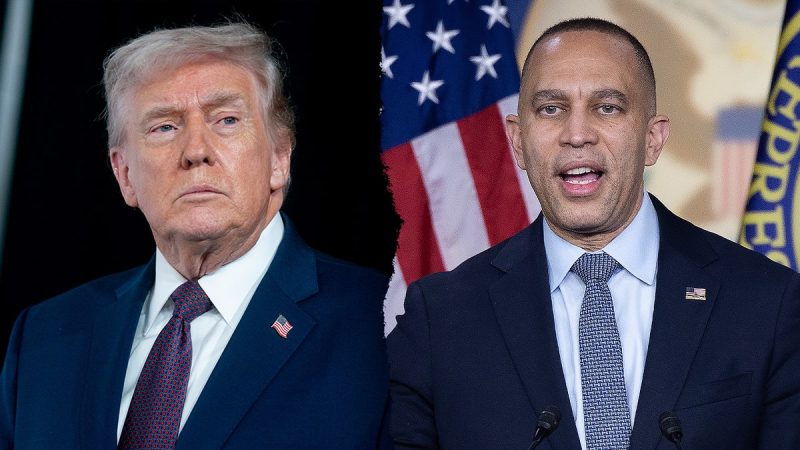
House sends bill ending government shutdown to Trump’s desk after 21 Dems break with Jeffries
The House of Representatives passed a federal funding bill aimed at ending the partial government shutdown on Tuesday, which will bring the four-day standoff to a close shortly after the legislation gets to President Donald Trump’s desk.
The funding bill, which passed the House 217-214, is a compromise struck between Senate Democrats and the White House that would fund roughly 97% of the federal government through the end of fiscal 2026.
Trump played an integral role in hashing out the new deal and quelling a subsequent rebellion by conservative lawmakers to get it over the finish line.
House Minority Leader Hakeem Jeffries, D-N.Y., signaled he was strongly against the plan, despite his Senate counterpart’s role in putting it together. But 21 Democrats bucked his concerns in the end to vote in favor of it.
Jeffries and his top lieutenants in the House Democratic Caucus all voted against the bill, however.
On the GOP side, 21 Republicans voted against the legislation while 196 were in favor.
Democrats had initially walked away from a bipartisan House deal to finish funding the federal government through the end of fiscal 2026 on Sept. 30, rebelling against a bill funding the Department of Homeland Security (DHS) over Trump’s handling of unrest in Minneapolis.
Their mutiny left roughly 78% of the government’s yearly funding hanging in the balance because the DHS bill was lumped into a wider package authorizing budgets for the departments of War, Labor, Health and Human Services (HHS), Transportation, Housing and Urban Development (HUD), and Education.
The deal struck between Senate Democrats and the White House would fully fund those remaining areas while only extending current funding levels for DHS through Feb. 13, in order to give Democrats and Republicans time to hash out a longer-term bipartisan plan.
Speaker Mike Johnson, R-La., told reporters on Tuesday that the legislation would succeed, though he hinted at some dissatisfaction with how negotiations played out.
‘This is not my preferred route. I wanted to keep all six bills together,’ Johnson said. ‘But listen, the president agreed with Schumer that they would separate Homeland, and we’ll do that, and we’ll handle it.… The Republicans are going to do the responsible thing.’
The Senate’s federal funding deal survived an important hurdle late Tuesday morning, clearing a House-wide ‘rule vote’ to allow for lawmakers to debate the measure and set up a vote on final passage by early afternoon.
It comes after a pair of House conservatives announced they would be backing off their threats to sink the legislation during the rule vote if the legislation was not paired with an unrelated election integrity bill called the SAVE America Act.
Reps. Anna Paulina Luna, R-Fla., and Tim Burchett, R-Tenn., warned they would not support the bill during the rule vote without the SAVE America Act attached but pivoted on Monday night after a conversation with the White House.
‘As of right now, with the current agreement that we have, as well as discussions, we will both be a yes on the rule,’ Luna said. ‘There is something called a standing filibuster that would effectively allow Sen. Thune to put voter ID on the floor of the Senate. We are hearing that that is going well, and he is considering that… so we are very happy about that.’
The SAVE America Act would require voter ID at the polls and create a new proof of citizenship mandate in the voter registration process.
But it appears Luna’s insistence that Thune had embraced the standing filibuster, a little-known and antiquated legislative maneuver, was not quite accurate.
Still, Thune said there were Senate Republicans who ‘expressed an interest in that, so we’re going to have a conversation about it. But there weren’t any commitments made.’
He noted that forcing the standing filibuster to try and pass the SAVE America Act, or any of its variations coming from the House, would be a massive drain on time in the Senate.
Doing so ‘ties up floor time indefinitely,’ Thune said. That’s because of rules that guarantee any senator gets up to two speeches on a bill. That, coupled with the clock being reset by amendments to the bill, means that the Senate could effectively be paralyzed for months as Republicans chip away at Democratic opposition.
‘There’s always an opportunity cost,’ Thune said.
‘Well, at any time there’s an amendment offered, and that amendment is tabled, it resets the clock,’ he continued. ‘The two-speech rule kicks in again. So let’s say, you know, every Democrat senator talks for two hours. That’s 940 hours on the floor.’
It’s not immediately clear when Trump will sign the funding bill, but it’s expected the White House will want to move fast. The longest government shutdown in history, which lasted 43 days, just ended in November.